The overhead 360 photo booth moves the machine off the floor entirely. A top spinner is suspended above the guests and rotates around them, so the capture happens over a dance floor, a stage or a product reveal — anywhere a platform cannot stand or should not be seen. Guests never step onto equipment; they step into a light circle and perform.
This is the format event producers choose when the floor is the show: fashion launches, car reveals, red carpets and club nights where a platform would break the scene. The suspended rig also hides cabling in the ceiling line, keeping photos of the event clean of machinery.
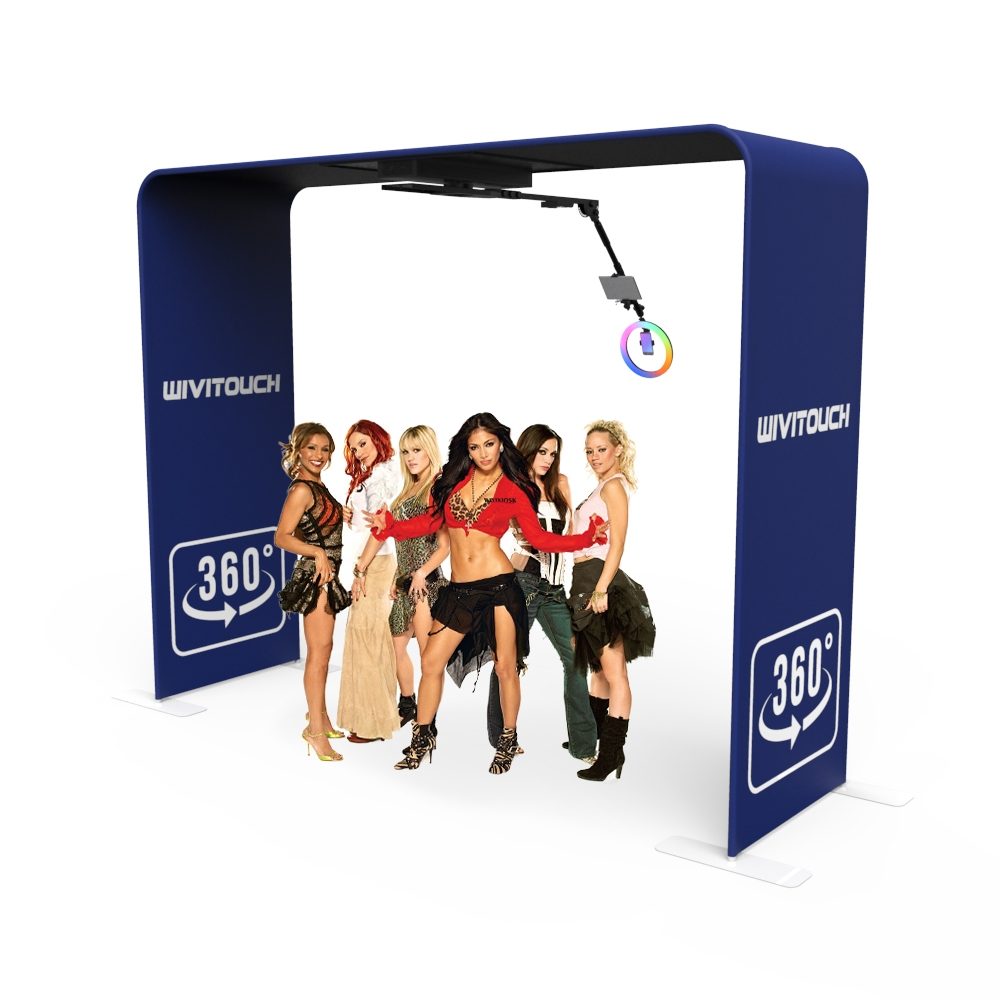
| Format | Ceiling-suspended rotating top spinner |
|---|---|
| Floor requirement | Open floor area; no platform |
| Capture style | Overhead orbiting video, slow-motion capable |
| Best for | Stages, launches, red carpets, dance floors |
| Rigging note | Venue ceiling/rigging point to be confirmed per installation |
| Warranty | 1 year (manufacturer-stated) |
Specifications are the manufacturer's published figures for this model. Configurations vary — the written quote states exactly what your build includes.
The rotating spinner hangs above head height, so there is no platform edge, no step up and no footprint competing with your set design.
Orbit a presenter, a product or a group on an open floor — the classic overhead use case at launches and award nights.
With no platform diameter limit, larger groups fit the shot; framing is set by the spinner height and camera angle.
Suspension keeps the hardware at the edge of vision, so guest photos and press shots show the event, not the rig.
Captured video runs through the same slow-motion, overlay and instant-sharing workflow as platform 360 content.
Fleets often run an overhead rig as the hero activation and a platform 360 as the second station at large events.
A platform 360 asks guests to come to the machine. An overhead 360 puts the machine where the guests already are — the middle of the party. Producers rig it over the busiest square metres of the room, so capture happens inside the atmosphere of the event rather than in a corner station, and the resulting clips carry the venue's energy with them.
It is also the practical answer for venues with protected floors, heritage spaces and exhibition stands where floor loads or fixings are restricted. Because the installation is per-venue, send us the ceiling height and rigging situation with your enquiry and the configuration will be matched to the room.
A suitable ceiling or truss rigging point above the capture area and standard mains power. Share ceiling height and rigging details with your enquiry so the configuration can be specified correctly.
The spinner is designed to be suspended and operated above head height with the capture zone kept clear beneath it. Your event safety plan should treat the rigging like any other suspended production equipment.
The clip format is the same — orbiting, slow-motion, shareable. The difference is framing freedom: overhead shots look down into the scene, which suits reveals and groups, while platform shots sit at guest eye level.
Yes — that is a common two-station layout at large activations, with the overhead as the hero piece.
Model, configuration, quantity and destination — that is all a real quote needs. A named manager replies.